
In recent years, as building regulations have tightened, many developers have grown anxious: can the requirements for nearly zero-energy buildings really only be met with a heat pump? The answer is: no. Through a real-world example, we show how the required energy performance levels can be achieved with infrared heating and combined solutions as well – and even save money in the process.
The case study – a newly built family home
The project concerns a newly built family home with a usable floor area of 97 m² (total volume: 252 m³), whose developer had originally planned heat-pump heating. By the time construction was due to begin, however, prices had risen so much that the investment was no longer affordable – so an alternative solution was sought. This is when infrared heating film came into the picture as a comfortable and economical option.
In the end, the following system was implemented in the property:
- 4 heating-cooling air-conditioning units were specified (living room + bedrooms), which covered 80% of the floor area, and therefore appeared in the energy performance certificate as the primary heat-pump heating.
- Infrared heating film was installed in every room for comfort, but plays only a supplementary role in the energy calculation.
- A heat-pump water heater (DHW) was set up to produce domestic hot water.
- The result of the energy assessment: A+ rating, CO₂ emissions: 17.53 kg/m²/year, aggregate energy performance indicator: 67.86 kWh/m²/year, which meets the stricter 2023 regulations with 5 kW of solar panels.
What happens if the client also plans a solar PV system?
We refined the calculations further for two different scenarios, for which separate calculations were prepared in the energy performance certificate:
🔹Option 1 – with a 2 kW solar PV system:
- Just 2 air-conditioning units would already have been enough for thermal compliance.
- The infrared heating remained in this case as well, but for the occupancy permit it was the capacity of the air-conditioning units that was decisive.
- The CO₂ emissions and energy performance indicators improved even further: CO₂: 14.88 kg/m²/year, aggregate indicator: 66.89 kWh/m²/year, i.e. it stayed comfortably within the A+ level with 2 kW of solar panels.
🔹Option 2 – with a 5 kW solar PV system:
- Here, there would have been no need at all for inverter air conditioning to meet the energy assessment.
- The entire building would have received the occupancy permit with infrared heating alone.
- Although only electric heating film featured as the heating system, it fully complied with the requirements with 5 kW of solar panels.
Conclusion – Don’t believe the myths!
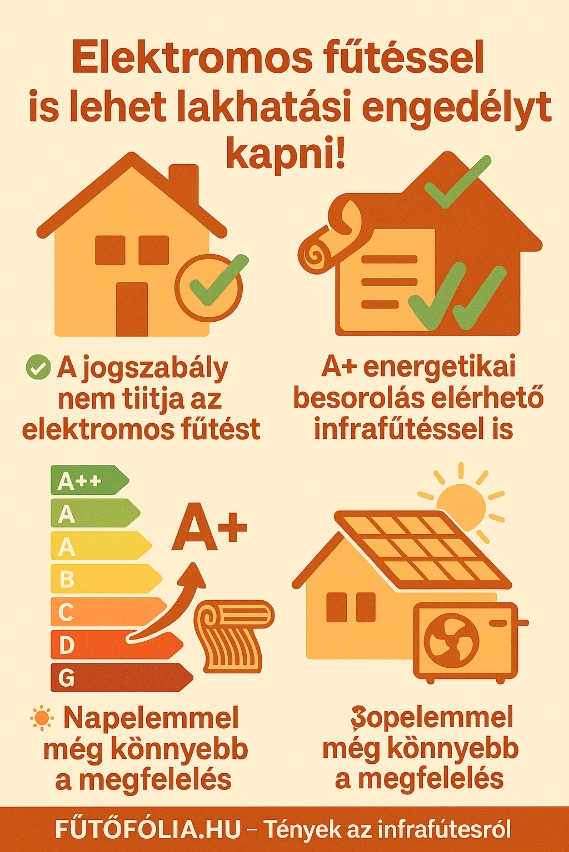
“You can’t get an occupancy permit with electric heating” – this is an outdated claim that modern energy software and regulations no longer support.
The truth is that a well-designed hybrid system (air conditioning + infrared heating), or infrared heating combined with a smaller solar PV system, can also fully comply with the 2023 ÉKM (Ministry of Construction and Transport) requirements.
➕Benefits for the developer:
- No need for complex, expensive mechanical systems.
- Faster, simpler installation.
- A more comfortable sense of warmth, especially with underfloor heating.
- With a future solar PV installation, even zero utility costs are achievable.
📞Plan it with us!
If you find yourself in a similar situation, or you have a client who is uncertain because of the heating, get in touch with us! Our team of energy engineers examines every project individually and works with a solution-focused approach – so that the occupancy permit never hinges on the heating.
Request a technical recommendation here.